
19. Oktober 2026
My AI Coding Workflow, October 2026
Nine months after my January snapshot: cloud VMs per thread, connections instead of skills, agents that watch production on a schedule, and 18 projects a day.
In February I wrote down how I worked in January 2026. A snapshot. I said in a year it would probably look outdated, maybe embarrassing.
It took nine months. Reading it now feels super embarrassing.
Not because it was wrong. Back then it worked. But almost every piece has moved: where the agent runs, how it gets context, what I do all day.
From My Laptop to Orbs
I never really got worktrees. Every time I tried them I ended up with trash everywhere, and the agents weren’t good at cleaning them up. So I did one thing at a time per project. Branch, finish, merge to main, next.
I watched cloud agents show up everywhere. Claude had them, ChatGPT had them, Cursor had them. None of it made sense for me, because my whole system was local. Skills, CLIs, secrets, all on my machines. Cloud meant: no access to anything. Why would I do that?
Then Amp launched Orbs. Every thread gets its own VM. You write a setup script once, it gets cached, and every new thread boots with the full project ready. They explained it best, honestly. And around August they started supporting the ChatGPT subscription, so I didn’t have to pay API prices anymore.
That’s when it clicked. I could move my CLIs over as skills, set them up once for the Orb, store secrets for it, and every Orb had everything. Same repo, four things in parallel, nobody fighting anybody.
I’d been close to switching for a long time. One day I just set it all up. It worked right away.
No more trash on my PC. One app, plus the mobile app.
A Day Now
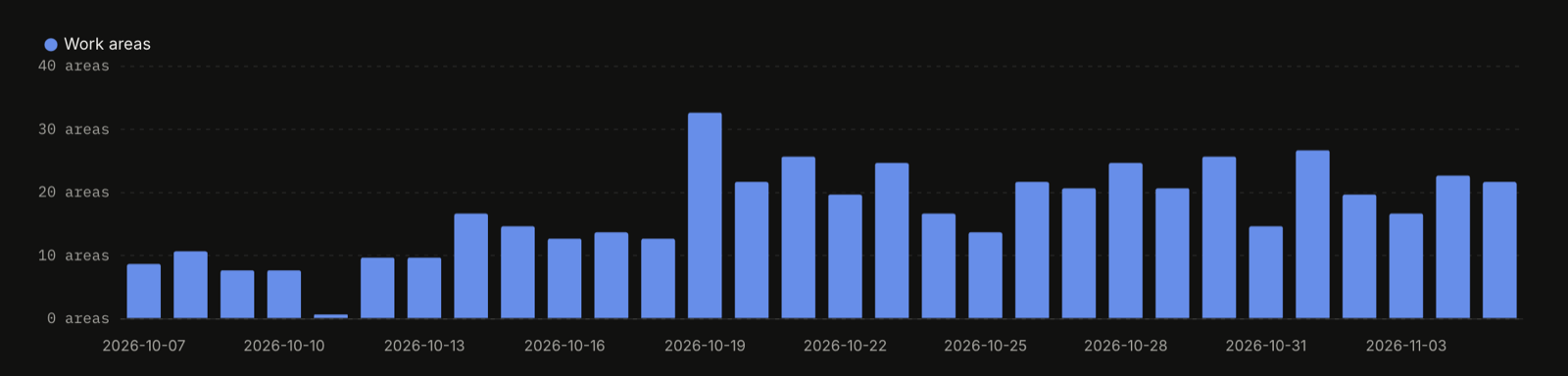
I built myself a metrics dashboard to actually see this. Right now I average about 18 projects a day. A project is a repo or an Amp project, usually the same thing.
Commits went with it. Around 50 a day in early October, mostly 100 to 200 a day since. That jump is mostly Claude. It lines up with switching back to Opus.
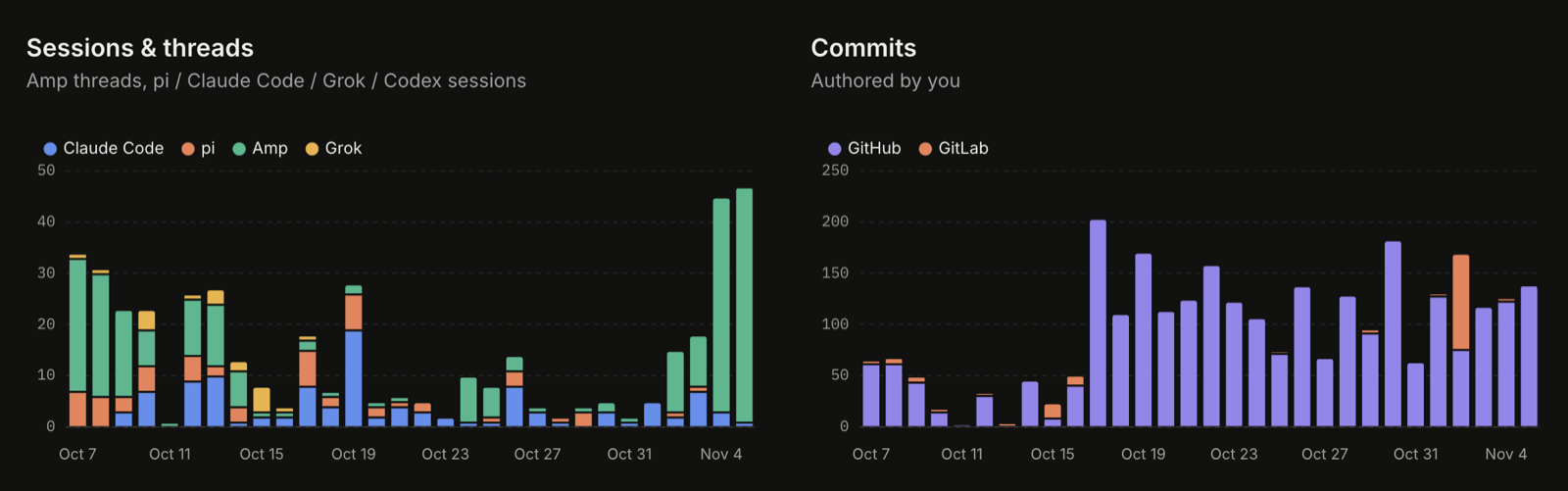
18 sounds chaotic. It isn’t, because most of it doesn’t need me:
- Threads I’m not working on get snoozed. The sidebar only shows what I’m on right now. I like it clean.
- Lots of things run on a schedule. A deploy went out, an agent checks regularly if anything broke. A client launched something, an agent looks every hour for errors. It only bubbles up to me when it’s relevant.
- New idea? Spin up an Orb, talk it in via speech-to-text, drop in a screenshot or two, and it starts working.
It’s gotten more and more low-touch. Even with many projects, the time I’m actually in each one is small.
I also use this for side stuff. I have apps for the gym and for running. After a run I open the Amp app and say: this part isn’t great yet, make it better. Walk through what I was just doing, what needs to change. Done.
You can talk so high level now. It’s unbelievable.
Proof, Not Promises
The full app runs inside the Orb, database and everything. The agent has a desktop and a browser in there, and it can expose the running app through a portal with a shareable URL.
I invested a lot of time making that setup really work. Now I just say: test this end to end. Amp has this famous line: give me irrefutable proof that this works. And it does. A video of the whole flow. Screenshots. A little HTML page showing what it built.
It tests on dev and on prod, because it has a browser for both. Honestly, I’d never have had the patience to QA that thoroughly myself. It’s insane.
So how do I feel about merging now? Good. Really good. The quality is just higher.
Connections, Not Skills
In January I had 35 skills and called each one a force multiplier. Today most of them are gone.
Most of my skills were never instructions anyway. They were CLIs wrapped around APIs so the agent could do things or look into a system. The skills that just said “here’s how you do X”? I always found those pointless. The agents figure that out on their own.
What replaced the CLIs is Executor. I’d watched it in my X bubble for a while. It gives the agent all your tools behind a simple code-mode-style search, so you can use MCPs without dumping every tool description into the context. Compaction also got a lot better, so long conversations don’t fall apart anymore.
Then Executor v2 added apps. My CLIs were already TypeScript and JavaScript, so I just had the agent port them over. Now everything lives there.
Per project I turn on one MCP for that use case, with exactly the connections the agent needs. For the project I’m building with a colleague, that’s Axiom for logs, PlanetScale for Postgres and Neeto for support tickets. Nothing else.
I also control what the agent may do through it. Answering tickets or sending emails? Blocked. I don’t have to think about it anymore.
And when someone hits a limitation, I tell the next agent: look at this app, someone tried to use it like this and ran into a wall. Fix it once, fixed for everyone, because it’s one app with many accounts.
So it’s still a multiplier. Just not the way I thought. The agent doesn’t need instructions. It needs access. My AGENTS.md files got trimmed down step by step too. Only the bare minimum left.
What’s left on the skill side: a few design rules for UI work and a verification skill so the agent can drive the UI and test its own changes. I didn’t write either of those myself.
24/7 Attention
Agents that watch production around the clock changed my work the most.
I already had a lot of infra checks running. Everything funnels into one notification app I built, push notifications on all my machines. App is down, event stuck somewhere, browser errors from Axiom or PostHog, new ticket. Now agents sit on top of that.
A client recently launched their product on a podcast. Lots of people buying at once. On a weekend.
For the days after the launch I ran an hourly automation that looked at everything: quality of the generated digital products, every error that showed up anywhere. Once an hour it checked, pinged me when something needed a decision, and I decided.
Only a few issues actually reached me through customers. And each time one did, I improved the observability, and you could watch the cases go down because we kept turning the big screws.
It was Sunday. I had a relaxed Sunday.
You’re not sitting there putting out fires anymore. You go straight from error to analysis to fix, and you’re barely involved. You have 24/7 attention if you want it. Nothing slips through.
Phone
It’s the same app with the same features everywhere. There’s no feature parity problem because there’s nothing to be at parity with.
Before this I had Moshi on my phone with a terminal into my machine. It worked well with Herdr, but it was half good, buggy, tiny screen, trying to resend the last command, voice sometimes not working. Shit terminal.
Now I mostly use voice on the phone because I don’t want to type. Something comes up while I’m out, I send a screenshot or a voice note, we work on it right away. Reaction time is basically instant.
Models and Money
In January: Opus 4.5. In the summer: ChatGPT, because that’s what got me into Amp.
When Amp added support for Claude subscriptions about a month ago, I switched back. Opus 5.5 is next level. You just send it off and it works until it has the proof. I couldn’t go back to ChatGPT, to be honest.
I run two Opus plans now. Token usage went up, obviously.
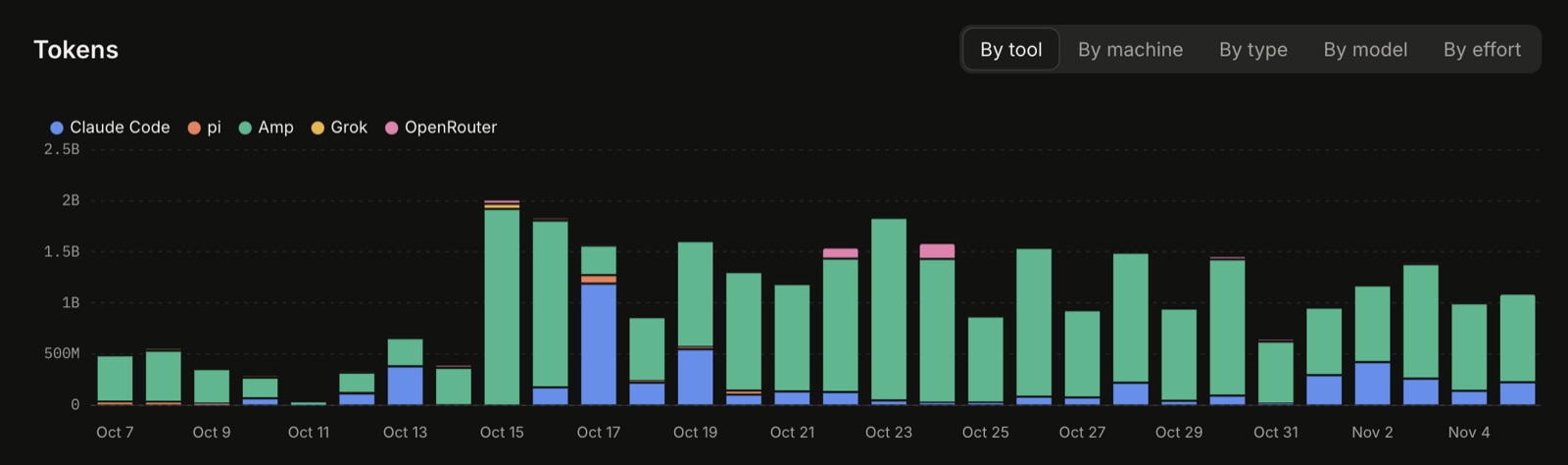
For this level of productivity it’s worth it.
Compute too. I blew past the included Orb limits quickly. Amp lets you register your own machines as Orb runners now, so the Docker containers spin up there and you keep the isolated sandboxes. Two of my computers are cloud runners now. They’re idle anyway. Apps build in the pipeline, I code in the VM, so they don’t need the fat RAM for me anymore.
GitLab worked but wasn’t integrated as well as GitHub. That was honestly the only thing I’d still complain about. Then, the day I was finishing this post, Amp shipped proper GitLab support. Merge requests, pipelines, spawners. So that’s gone too.
What People Get Wrong
I went heavy on skills too. A lot of people now use them to over-constrain the agent. Super involved setups, trying to force the agent onto rails. That’s not needed anymore.
Give the agent a way to verify its work. Give it eyes and ears. Then get out of the way.
People also keep tinkering with their setup, rebuilding what already exists. I saw a tweet around the time I switched that nailed it. You can tweak your own setup forever, or you take the tool where people put their heart into it and everything’s already solved. And it keeps getting better, almost daily. The Amp team tweets about everything, you can follow along, they’re all fired up about it.
I was with pi for a long time. Now I’m loyal to this, because nothing’s missing.
And people are still too scared. You can trust it more now. If the agent has eyes, not much can go wrong. The Amp team doesn’t do merge requests anymore. Everything goes to main, deploys automatically, gets tracked, behind feature flags.
You have to rethink everything. You don’t have the same limits anymore. Be way more ambitious.
My Job Now
Still the puppet master, I’d say. Maybe more product manager now.
I think about security, ops and architecture at a higher level. I don’t have to nudge the agent to keep going anymore. It works until it has brought the proof. That was definitely different in January.
Technical details matter less and less. What matters is understanding processes. The attention comes for free. So you can wow clients, because you’re extremely fast and extremely precise. There’s nothing left you’d have to hold back because it would be too much.
February 2027
I’m more standardized now than I was in January. Still experimental, just on a different level.
What will look embarrassing in three months? No idea. Probably that I still looked at anything myself. More hands-off, more proactive, more ambition, more ideas.
Three months isn’t long. But a lot happens in three months. Let’s see.
Ein ähnliches Problem? Schreib mir.